
A sanctioned Chinese tanker slipped through the Strait of Hormuz on Tuesday, punching a hole in the US naval blockade less than 48 hours after it took effect.
The Rich Starry, a medium-range chemical tanker blacklisted by Washington in 2023 for helping Iran dodge energy sanctions, became the first vessel to exit the Persian Gulf since CENTCOM began enforcing Trump's blockade order on Monday. Shipping data from LSEG confirmed the transit. The vessel was carrying roughly 250,000 barrels of methanol loaded at the UAE's Hamriyah port, bound for China.
The US Navy did not intercept the ship.
First it turned back. Then it didn't.
The Rich Starry's journey tells the story of this blockade in miniature. When enforcement kicked in at 10 a.m. ET Monday, the Malawi-flagged tanker initially reversed course within 20 minutes of approaching the strait, according to MarineTraffic. It broadcast its status as "drifting" off Qeshm Island for several hours.
By Tuesday, something changed. The tanker pushed through and made it out.
What happened in between was a burst of public diplomacy from Beijing. China's Defense Minister Admiral Dong Jun declared that Chinese vessels would keep transiting Hormuz under existing agreements with Tehran. "Our ships are moving in and out of the waters of the Strait of Hormuz," Dong said. "We have trade and energy agreements with Iran. We will respect and honor them and expect others not to meddle in our affairs."
He added that Beijing was "committed to peace and stability" and not seeking a direct military confrontation with the United States. But the message was plain: China will not stop shipping through Hormuz because Washington tells it to.
CENTCOM's fine print
The Pentagon left itself an opening. CENTCOM clarified that the blockade targets Iranian ports specifically and "will not impede freedom of navigation for vessels transiting the Strait of Hormuz to and from non-Iranian ports." The Rich Starry loaded at a UAE port, not an Iranian one. That distinction gave the Navy a reason not to act.
But the optics cut deeper than the legal footnotes. Maritime records in the Equasis database link the Rich Starry's registered owner, Full Star Shipping Ltd., to the Shanghai-based firm Xuanrun Shipping Co. The State Department has sanctioned both. A US-blacklisted vessel with Chinese crew sailed past the Fifth Fleet without consequence. Traders noticed.
Oil slides on the signal
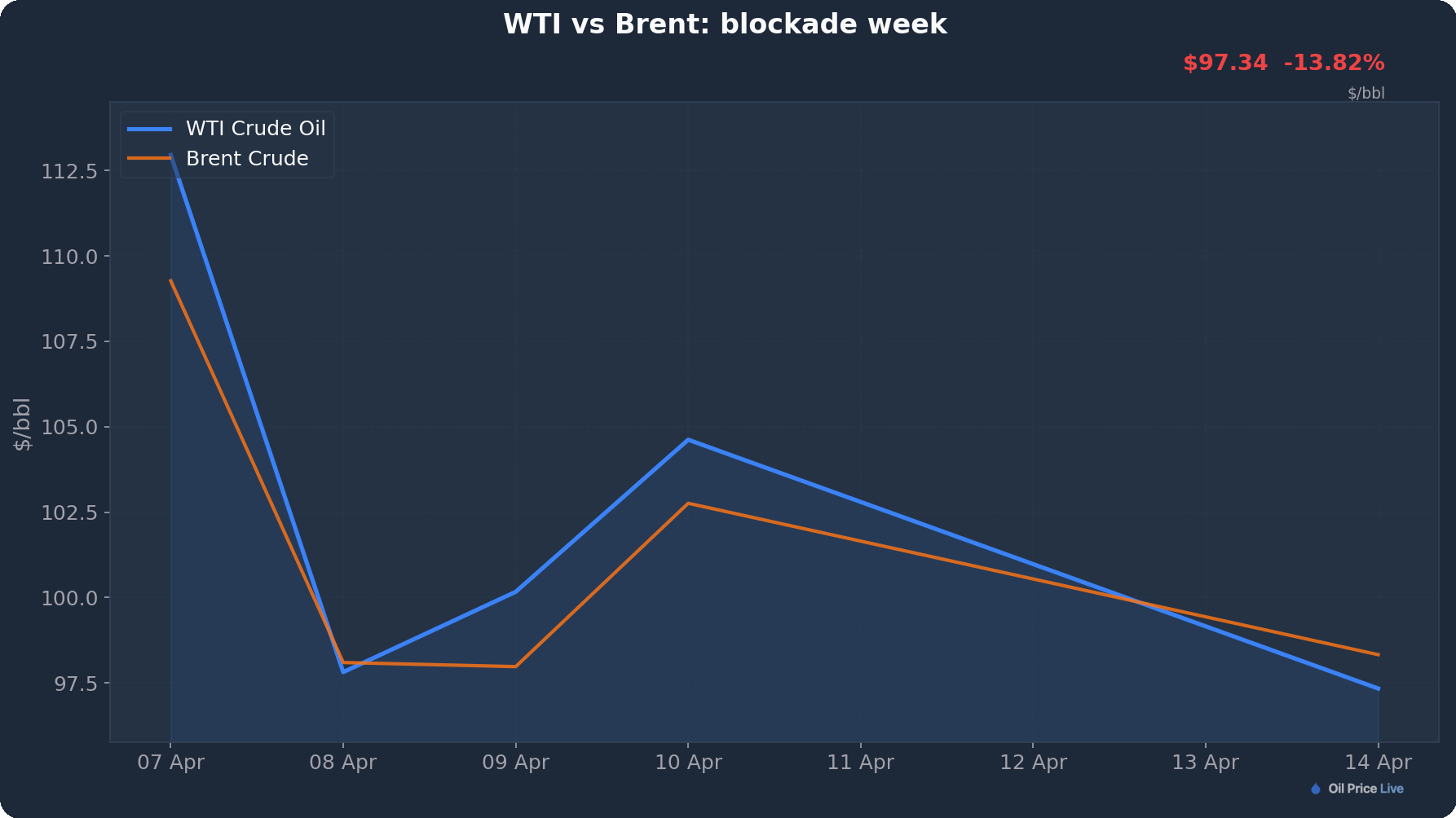
Crude dropped on Tuesday as the Rich Starry's transit rippled through the market. WTI fell 1.8% to $97.34 a barrel. Brent slid 1.1% to $98.33. Both benchmarks had surged 7% on Sunday night when Trump announced the blockade after peace talks in Islamabad collapsed.
The sell-off reflects a fast repricing of the blockade's credibility. If China can move ships through Hormuz freely, the supply picture shifts. Beijing is Iran's largest oil customer, and any arrangement that keeps Chinese tankers moving undercuts the pressure campaign that justified the blockade in the first place.
This is not the first time Chinese vessels tested the strait during the crisis. Three Chinese-operated supertankers transited Hormuz on April 9 under the ceasefire, carrying roughly 6 million barrels between them. That transit happened before the blockade. Tuesday's was different because it happened after the US Navy said it would enforce one.
What it means for the blockade
Washington now faces a choice it clearly wanted to avoid. The Rich Starry carried methanol, not crude oil, and loaded outside Iran. A Chinese crude tanker departing from Bandar Abbas or Kharg Island would be a sharper test.
Iran granted transit rights to ships from five nations back in March: China, Russia, India, Iraq, and Pakistan. If all five start pushing tankers through, the blockade becomes a filter that stops Western and allied shipping while letting Iranian trade partners through.
The ceasefire holds until April 22. Eight days remain for diplomacy to produce something. But the blockade has already exposed a structural weakness: the US can shut down commercial shipping from most countries, but it cannot shut down Chinese shipping without risking a confrontation that goes far beyond Iran.
For oil traders, that means the blockade leaks. And a leaky blockade does not hold $100 oil.