
The clock runs out Tuesday night
The two-week ceasefire between the United States and Iran expires Tuesday, April 22, at 8 p.m. ET. As of Monday afternoon, neither side has confirmed it will extend the truce or show up for a second round of negotiations in Islamabad.
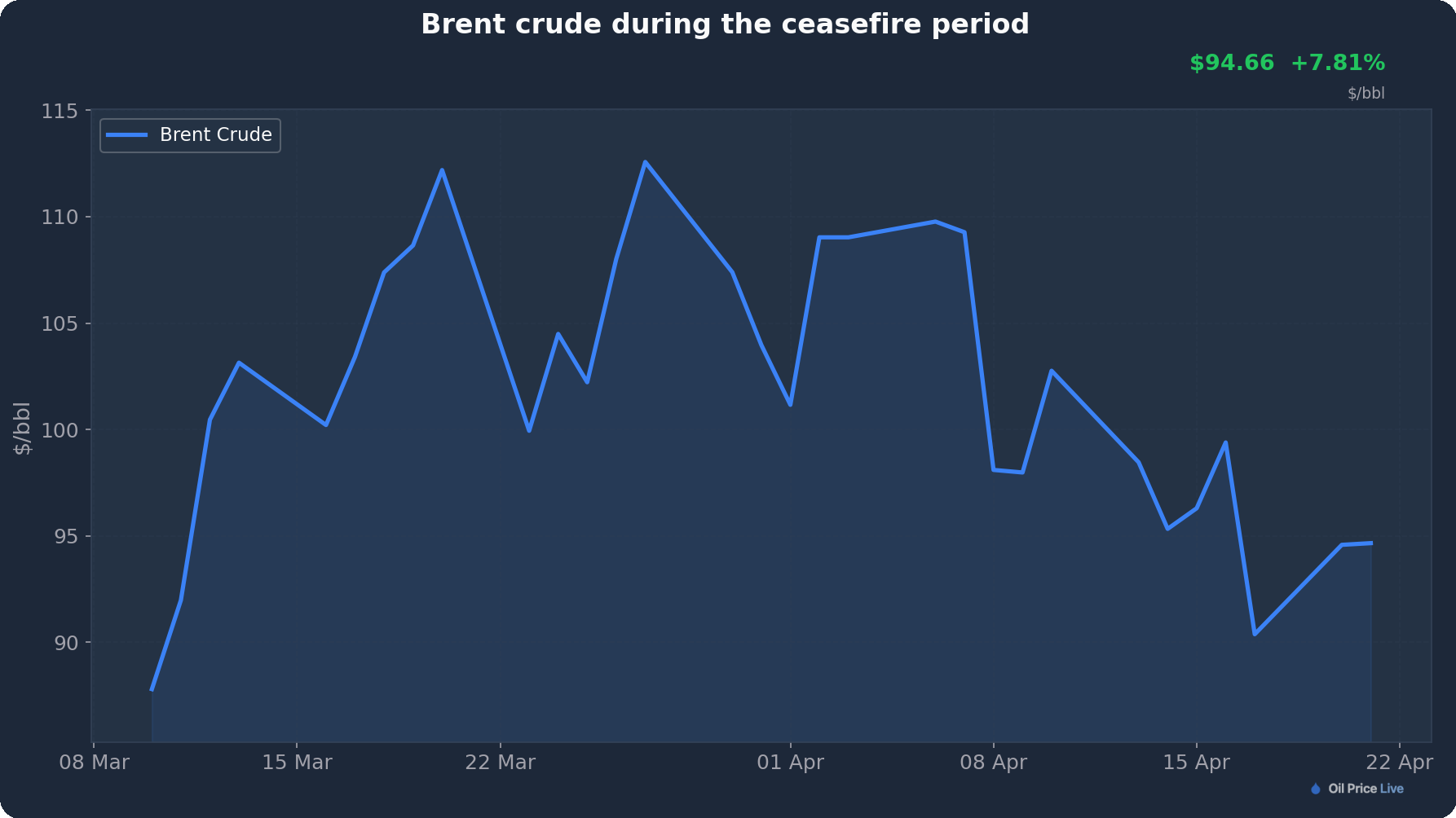
Brent crude traded at $94.53 per barrel on Monday, down 1%. WTI fell to $86.23, a drop of nearly 4%. Prices dipped as some traders held onto fading hopes that last-minute diplomacy could restart.
Tehran walks away, then hedges
Iran's First Vice President Mohammad Reza Aref called American demands "childish" and accused Washington of violating the truce by maintaining its naval blockade. State media confirmed Tehran would skip the planned second round in Pakistan.
But the signals are mixed. Parliament speaker Mohammad Bagher Ghalibaf told reporters Iran is "positively reviewing" participation, even as Iran's president warned of "deep historical mistrust" and rejected negotiating "under the shadow of threats."
Ghalibaf also added a military edge to the hedging. Iran, he said, has "prepared to reveal new cards on the battlefield."
Trump's position: no extension, no concessions
President Trump posted on Truth Social that an extension is "highly unlikely" and that he would "not be rushed into making a bad deal." In a separate post, he threatened to "knock out every single Power Plant, and every single Bridge, in Iran" if Tehran refuses America's terms.
Vice President JD Vance, joined by envoys Jared Kushner and Steve Witkoff, is reportedly preparing to return to Islamabad. Neither delegation has confirmed it will actually be there when the clock hits zero.
Three sticking points, zero progress
The talks collapsed over the same three issues that derailed the first round on April 11:
- Iran's nuclear enrichment program. Washington and Tel Aviv demand full dismantlement. Tehran's 10-point proposal insists on retaining enrichment rights.
- Regional proxies. The US wants Iran to cut support for Hezbollah and other armed groups. Iran views them as non-negotiable.
- Control of the Strait of Hormuz. Iran has mined sections of the waterway and is charging ships up to $2 million for passage. Washington says the strait stays blocked until a deal is signed.
What the oil market faces after Tuesday
If the ceasefire lapses without a deal or an extension, traders are bracing for several scenarios.
Strait stays shut. Roughly 230 loaded oil tankers are trapped inside the Persian Gulf. The IEA estimates 9.1 million barrels per day of supply has been shut in, the largest disruption in oil market history. Physical crude has already traded near $150 per barrel in spot markets, even as futures hover in the $86-95 range.
Strategic reserves drain faster. IEA members released a record 400 million barrels from emergency stockpiles on March 11. Analysts say that buffer lasts about five months at current drawdown rates. Global stocks fell 85 million barrels in March alone, with a 5.1 million barrel per day drawdown projected for the second quarter.
Demand destruction accelerates. The IEA now projects global oil demand will contract by 80,000 barrels per day in 2026, the first annual decline since the pandemic. US retail gasoline prices are forecast to peak near $4.30 per gallon this month. Diesel in Singapore has hit record levels above $290 per barrel.
The US Treasury waiver is gone too
One thing many traders missed this weekend: a temporary Treasury exemption that had allowed buyers to pick up Iranian crude stuck on tankers at sea is expiring. Washington confirmed it will not grant an extension, removing a quiet safety valve that kept some Iranian barrels flowing even during the blockade.
What to watch
Negotiations could still restart Tuesday night or Wednesday morning in Islamabad, according to Pakistani officials preparing the venue. But preparing a conference room and having both delegations sit down in it are not the same thing.
Both sides have mostly kept to the two-week truce, though Iran hit targets across the Gulf and Israel bombed southern Lebanon during the pause. Whether it survives another 24 hours, with both sides trading threats on social media and firing warning shots in the strait, is the question oil markets will price in at Monday's close.