
Forty days of war premium, gone in thirty minutes
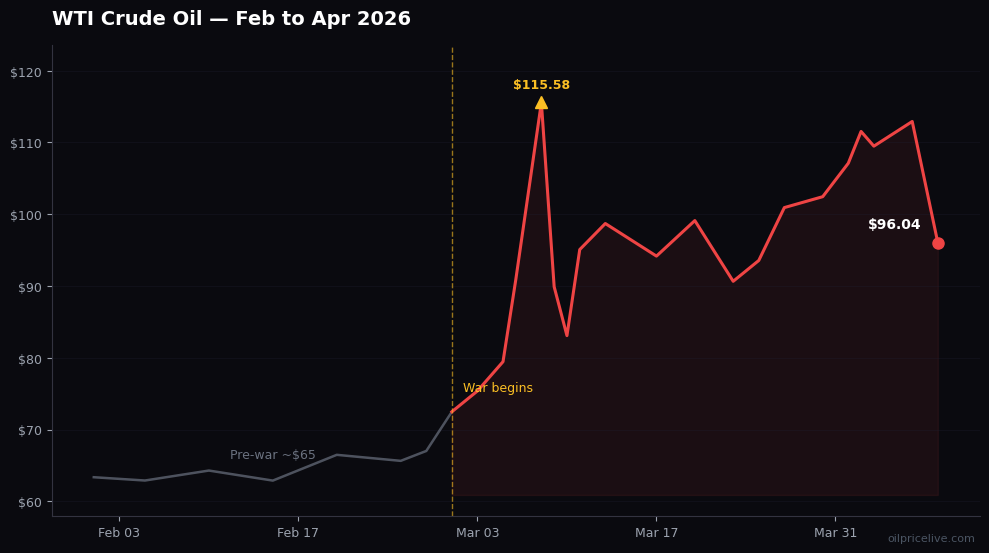
WTI crude dropped as low as $91.11 per barrel on Tuesday evening, down from an intraday high near $109, after President Trump announced he would suspend strikes on Iran for two weeks. Brent fell to $90.01 before recovering slightly. At last check, WTI traded at $96.04, shedding nearly 17% on the session, while Brent sat at $94.50, off almost 15%.
That makes it the steepest single-day oil sell-off since January 1991, when prices cratered 33% at the start of the Gulf War air campaign.
The deal came together in the final hours before Trump's 8 p.m. ET deadline. It was the same ultimatum he had threatened would bring the end of "a whole civilization" if Iran refused to comply. Pakistani Prime Minister Shehbaz Sharif brokered a last-ditch proposal for a two-week pause, giving both sides room to negotiate without the bombs falling.
What Tehran agreed to, and what it didn't
Iran's top security body signed off on the pause, but with a significant caveat: any ship wanting to pass through the Strait of Hormuz must first get clearance from Iran's military. Tehran is framing this as continued sovereignty over the waterway, not a concession. Shipping companies are already asking what that process will look like in practice.
Trump demanded a "complete, immediate, and safe opening" of the strait. Iran's version stops well short of that language, but it was apparently enough. Planned strikes on Iranian power plants and key bridges were called off within an hour of the announcement.
Formal negotiations begin Friday in Islamabad, with Pakistan hosting.
How the sell-off unfolded
Oil was already coiled heading into the session. WTI had touched $116 earlier this week as traders braced for an expired deadline to escalate into full-scale infrastructure strikes. When the ceasefire hit the wires, algorithmic selling cascaded through crude futures.
Within half an hour, WTI had shed more than $20 a barrel. Brent followed, losing $14 in the same window. The speed caught traders off guard. Screens turned green almost everywhere else.
Stock markets moved the other way. Dow futures surged 967 points. S&P 500 and Nasdaq 100 futures both jumped over 2%. In Asia overnight, South Korea's Kospi rallied 5.8% and Japan's Nikkei gained nearly 5%.
Prices are still nowhere near normal
Both benchmarks remain far above pre-war levels. Oil sat around $73 when the conflict started in late February. Even after Tuesday's crash, crude is roughly 30% more expensive than it was six weeks ago.
The Strait of Hormuz has been effectively shut for most of the past 40 days, choking off roughly 20% of seaborne oil trade worldwide. Getting tanker traffic flowing again, assuming Iran actually waves vessels through, will take days at a minimum. Not hours.
And the ceasefire itself is fragile. Two weeks is not a peace deal. Iran gave no ground on its nuclear program, and its parliament recently voted to make Hormuz transit fees permanent. Trump has shown no hesitation about restarting strikes if talks stall.
Gasoline at the pump sits at $4.14 a gallon nationally, according to AAA. Some analysts project it could dip below $4 by the end of the week. That depends entirely on whether ships start moving.