
A fleet with nowhere to go, until now
The ceasefire stunned oil markets. Brent and WTI both crashed below $95 on Tuesday night, their steepest single-day drop since 1991. But for the 800-plus vessels stuck in the Persian Gulf, the real question isn't what oil costs anymore. It's whether they can actually get out.
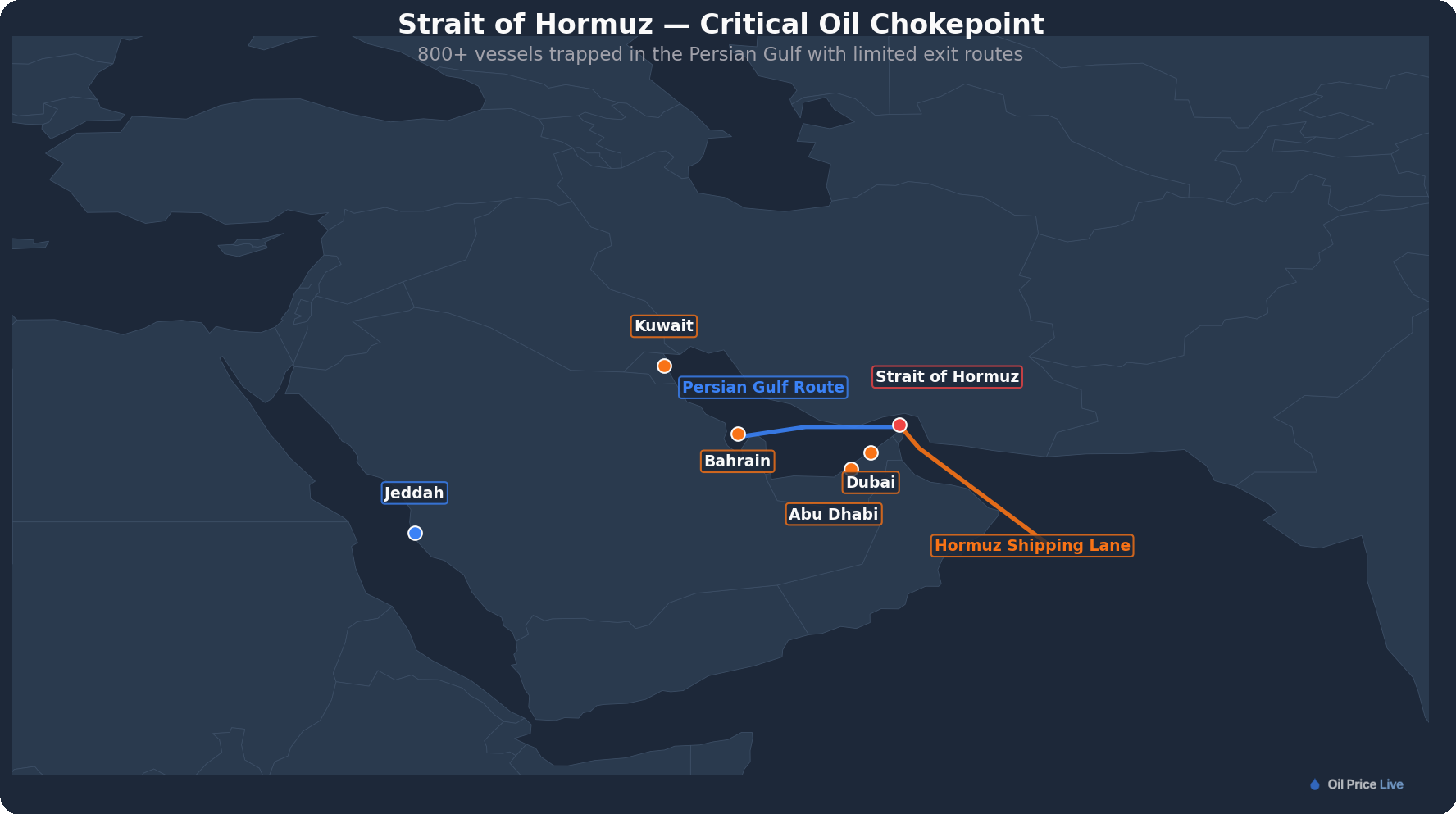
Since Iran effectively shut the Strait of Hormuz in late February, daily transits have collapsed from roughly 130 ships to just six. More than 426 crude and product tankers, 34 LPG carriers, and 19 LNG vessels sit idle across the Gulf, according to an International Maritime Organization tally. Around 20,000 civilian seafarers remain aboard, many for over five weeks straight.
Two versions of "open"
Washington and Tehran agreed to a two-week truce late Tuesday, but they're already telling different stories about what it means.
Trump posted on Truth Social that the Strait would see a "COMPLETE, IMMEDIATE, and SAFE OPENING." Iran's Foreign Minister Abbas Araqchi offered a different reading: safe transit would be possible "via coordination with Iran's Armed Forces and with due consideration of technical limitations."
What that looks like in practice is a bureaucratic obstacle course. A ship wanting out must go through an intermediary connected to the Revolutionary Guard, handing over details on its flag, cargo, crew, and commercial history. The IRGC's provincial naval command in Hormozgan then runs background checks to screen out any connection to the US or Israel. Ships that pass get a radio code and a set of GPS waypoints to follow through the strait. Some draw an armed escort.
That pipeline moved a handful of tankers in March. Pushing 800 vessels through it in fourteen days is something else entirely.
$14 million just to move
Ships cleared to leave still face brutal economics. Lloyd's List reports that war-risk insurance on Hormuz transits costs between 1.5% and 3% of a vessel's hull value. Put that on a VLCC, the supertankers built to carry two million barrels of crude, and the bill lands between $10 million and $14 million for a single trip. Owners of American-, British-, or Israeli-flagged ships can expect to pay triple.
Layer on the transit tolls Iran's Revolutionary Guard introduced in March, up to $2 million per crossing, and the cost of simply leaving the Gulf rivals the value of some smaller cargoes.
20,000 people waiting
The human toll runs deeper than shipping delays. On April 2, IMO chief Arsenio Dominguez addressed officials from more than 40 nations and described conditions of "dwindling supplies, fatigue and severe psychological stress" among stranded crews. The International Transport Workers' Federation has been flooded with over 1,000 distress emails from sailors stuck on these vessels, many begging to go home.
Twenty-one attacks on merchant ships have been recorded since February 28. Ten crew members did not survive.
Months to normalize, even if the truce holds
Henning Gloystein, managing director for energy at the Eurasia Group, estimates that rebuilding normal Gulf shipping lanes would take a minimum of two months after any ceasefire. Crew rotations, fresh insurance contracts, and damaged port infrastructure all need sorting out first. Maersk said the two-week window "could open some opportunities" but doesn't yet offer enough certainty to resume regular sailings. The bigger question is whether any carrier wants to risk a billion-dollar tanker in a corridor that might slam shut on April 22.
Brent crude settled near $94 on Wednesday morning, down more than 15% overnight. The futures curve had already been pricing in a resolution before year-end, with December contracts around $85 last week. Tuesday's crash suggests the spot market caught up to that bet in a single session.
But the 800 ships anchored across the Gulf aren't trading futures. They need a physical lane through a 21-mile-wide strait, and Iran has spent five weeks proving it can shut that lane whenever it chooses.