
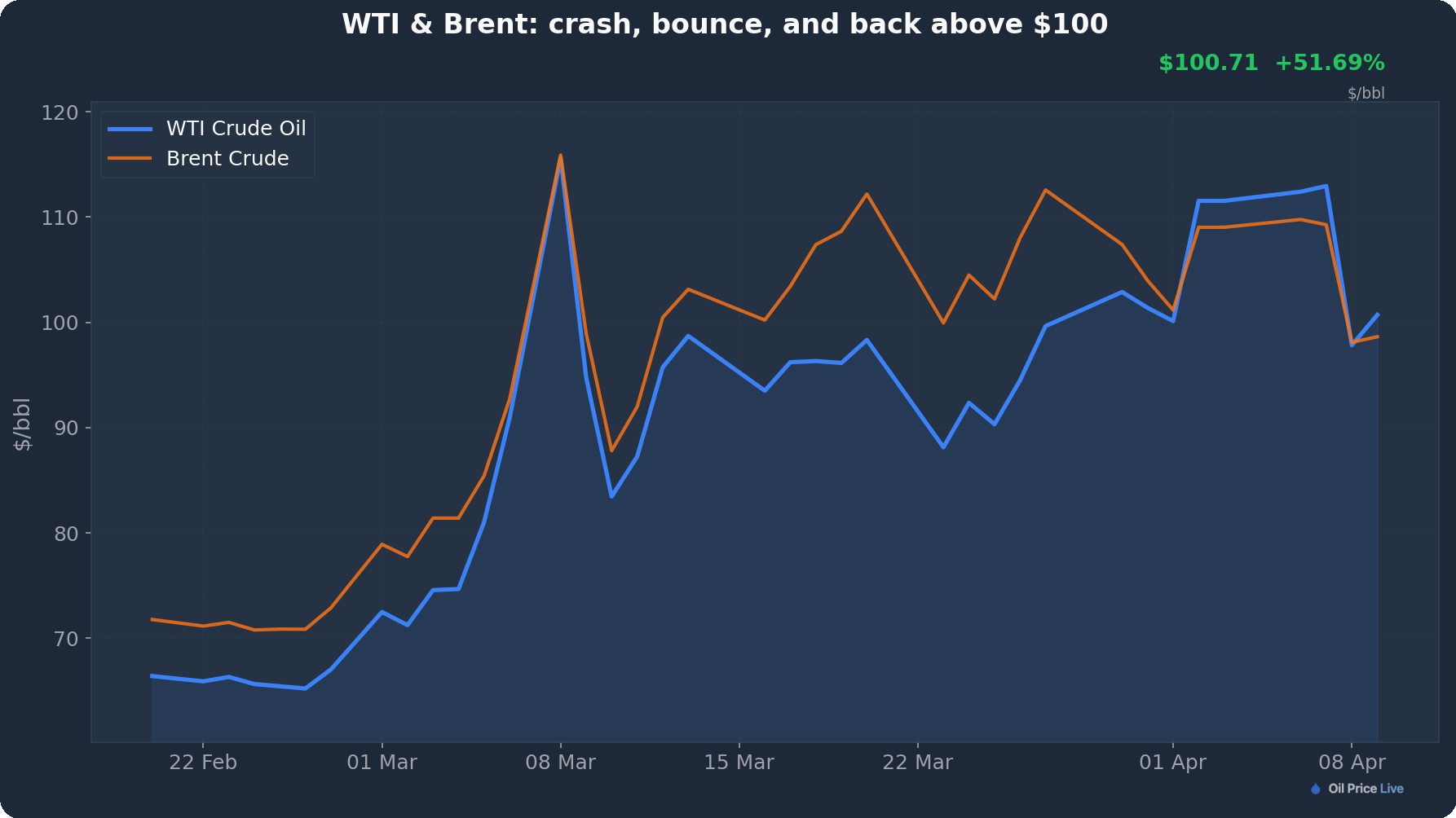
WTI crude crossed back above $100 on Thursday, climbing more than 6% and erasing roughly half of Wednesday's historic plunge. Brent pushed toward $99. The ceasefire that triggered a 16% crash just 24 hours ago is already fraying, and the market is repricing accordingly.
Iran accused the US of violating three elements of its 10-point truce proposal after Israel continued striking Lebanon. The strait, which briefly reopened for two tankers Wednesday morning, is shut again. Iran's parliamentary speaker Mohammad Baqer Qalibaf, who leads Tehran's negotiating team at Saturday's Islamabad talks, called the breaches unacceptable.
Goldman raises the stakes
Goldman Sachs published a note Thursday with a blunt warning: if the Strait of Hormuz stays mostly closed for one more month, Brent crude will average above $100 a barrel for all of 2026.
The bank laid out three scenarios:
| Scenario | Brent forecast |
|---|---|
| Ceasefire holds, Hormuz reopens | Q2 $90, Q3 $82, Q4 $80 |
| Hormuz shut one more month | Above $100 average for the year |
| Prolonged closure, 2M bpd lost | $120 in Q3, $115 in Q4 |
Goldman trimmed its Q2 numbers to $90 Brent and $87 WTI after the ceasefire was announced Wednesday. But the bank made clear those cuts assume the strait actually reopens. If it doesn't, the math flips entirely.
The analysts described the Hormuz disruption as the largest oil supply shock on record, bigger than the 1973 Arab embargo on a barrels-per-day basis.
Why the crash is being erased
Wednesday's sell-off priced in a scenario where Hormuz reopens and the war premium disappears. That bet lasted about eight hours before Iran re-closed the strait over Israel's Lebanon strikes.
Three factors are pushing prices back up:
- Hormuz is still shut. No tanker has crossed since Wednesday morning. The 800-plus vessels trapped in the Gulf aren't going anywhere.
- The ceasefire is fracturing. Iran says the deal covers Lebanon. Israel and the US say it doesn't. Both sides are digging in before Saturday's Islamabad negotiations.
- Demand hasn't gone away. Five weeks of shut-in Gulf production drained global inventories. Even a temporary reopening wouldn't refill them quickly.
What the price action tells us
WTI went from $116 to $92 to $100 in 48 hours. That kind of volatility signals a market that has no conviction about what happens next. Wednesday's sellers are now Thursday's buyers.
Goldman's base case assumes Hormuz traffic gradually returns. But the bank's own upside scenarios carry more weight today than they did yesterday, because the ceasefire is weaker than anyone expected it to be 24 hours ago.
Saturday's talks in Islamabad will set the next direction. Until then, oil stays volatile and anchored near triple digits.